
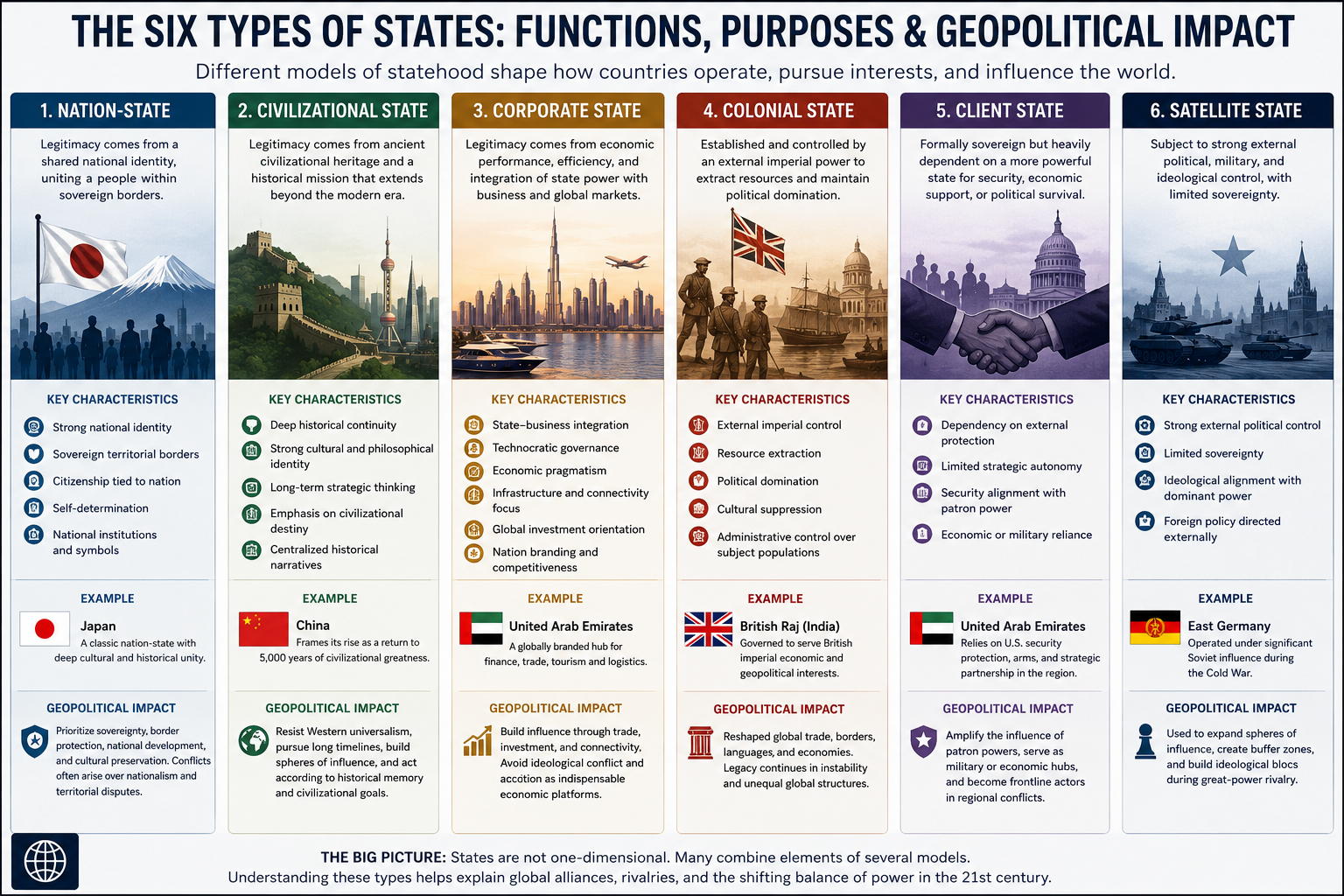
Understand the nature of the “State” is key
In political science, the term state does not simply refer to a country. A state is a political entity with authority over a defined territory, population, and governing structure. However, not all states operate according to the same logic, historical foundations, or geopolitical objectives.
Some states derive legitimacy from national identity, others from civilization, economic power, ideology, foreign patronage, or imperial conquest. Understanding these distinctions is essential because the behavior of states on the world stage is often shaped less by their constitutions and more by the underlying model they represent.
The modern international system contains several dominant state archetypes: the nation-state, civilizational state, corporate state, colonial state, client state, and satellite state. While some countries fit neatly into one category, many modern states combine elements of several simultaneously.
The Nation-State
A nation-state is a political entity where the state seeks legitimacy from a shared national identity, language, ethnicity, culture, history, or collective consciousness. The central idea is that the nation and the state should overlap.
This model emerged strongly after the Treaty of Westphalia (1648) and expanded globally during the 19th and 20th centuries alongside nationalism.
Key Characteristics
- Strong national identity
- Sovereign territorial borders
- Citizenship tied to national belonging
- Emphasis on self-determination
- National institutions and symbols
Example: Japan
Japan is often viewed as a classic nation-state because of its relatively unified cultural, linguistic, and historical identity. The Japanese state derives much of its legitimacy from continuity of national civilization and social cohesion.
Geopolitical Impact
Nation-states tend to prioritize:
- Territorial sovereignty
- Border protection
- National economic development
- Preservation of cultural identity
Conflicts between nation-states frequently arise over nationalism, territorial disputes, or competing historical narratives.
The Civilizational State
A civilizational state sees itself not merely as a modern political entity, but as the political expression of an ancient civilization spanning thousands of years. Its legitimacy comes from historical continuity, cultural inheritance, and civilizational mission rather than solely from modern nationalism.
Civilizational states often reject the idea that Western liberal democracy is the only valid political model.
Key Characteristics
- Deep historical continuity
- Strong cultural and philosophical identity
- Long-term strategic thinking
- Emphasis on civilizational destiny
- Centralized historical narratives
Example: China
China frequently presents itself as a 5,000-year-old civilization temporarily interrupted by colonial humiliation and now returning to historical centrality. The modern Chinese state frames its rise as a “civilizational rejuvenation.”
Other Examples
- India
- Iran
- Russia (increasingly framed this way)
Geopolitical Impact
Civilizational states often:
- Resist Western political universalism
- Pursue long strategic timelines
- Emphasize regional spheres of influence
- View geopolitics through historical memory
This model is increasingly shaping the emerging multipolar world order.
The Corporate State
A corporate state is a system where economic interests, state power, and major corporations become deeply integrated. The state operates partly like a corporation prioritizing efficiency, investment, branding, trade networks, infrastructure, and global capital flows.
Historically, “corporatism” referred to cooperation between government, labor, and business sectors. In modern geopolitics, the term often describes states whose legitimacy is strongly tied to economic performance and commercial functionality.
Key Characteristics
- State-business integration
- Technocratic governance
- Economic pragmatism
- Heavy infrastructure development
- Global investment orientation
- Branding of the nation as an economic hub
Example: United Arab Emirates
The UAE functions in many ways as a corporate state. Dubai and Abu Dhabi operate as globally branded economic platforms focused on finance, logistics, tourism, aviation, energy, and real estate. Governance is highly centralized and strategically oriented toward economic competitiveness.
Other Examples
- Singapore
- To some extent, Saudi Arabia under Vision 2030 reforms
Geopolitical Impact
Corporate states tend to:
- Avoid ideological conflict
- Act as commercial intermediaries
- Attract foreign capital aggressively
- Build influence through trade and investment rather than military power alone
Their stability often depends heavily on economic performance and external financial integration.
The Colonial State
A colonial state exists primarily to control territory and extract resources for an external imperial power. Colonial states historically subordinated local populations politically, economically, and culturally.
The colonial state was one of the dominant structures of European imperialism from the 16th to 20th centuries.
Key Characteristics
- External imperial control
- Resource extraction
- Political domination
- Cultural suppression
- Administrative governance over subject populations
Example: British Raj
British-controlled India was governed largely to serve imperial economic and geopolitical interests. Railways, ports, taxation systems, and military infrastructure were designed primarily around British strategic objectives.
Other Historical Examples
- French Algeria
- Belgian Congo
- Dutch East Indies
Geopolitical Impact
Colonial states reshaped:
- Global trade systems
- Ethnic borders
- Language distribution
- Economic dependency patterns
Many modern conflicts in Africa, the Middle East, and Asia trace directly back to colonial-era borders and governance structures.
The Client State
A client state is formally sovereign but heavily dependent on a more powerful external state for security, economic support, or political survival. The patron state exerts substantial influence over the client’s foreign policy and strategic behavior.
Key Characteristics
- Dependency on external protection
- Limited strategic autonomy
- Security alignment with patron power
- Economic or military reliance
Example: United Arab Emirates
The UAE is often described as a client state of the United States in security terms due to its reliance on American military protection, arms systems, intelligence cooperation, and regional strategic alignment.
Other Examples
- South Korea relative to the United States
- Belarus relative to Russia
Geopolitical Impact
Client states frequently:
- Amplify the regional influence of larger powers
- Serve as military or economic hubs
- Become frontline actors in proxy conflicts
Their stability often depends on maintaining favor with the patron state.
The Satellite State
A satellite state is more tightly controlled than a client state. While a client state retains some strategic flexibility, a satellite state is effectively subordinated politically, militarily, and ideologically to a dominant power.
The term became especially associated with the Cold War.
Key Characteristics
- Strong external political control
- Limited sovereignty
- Ideological alignment with dominant power
- Foreign policy directed externally
Example: East Germany during the Cold War
East Germany operated under substantial Soviet influence. Domestic governance, military alignment, and strategic policy were closely tied to Moscow.
Other Historical Examples
- Poland under Soviet influence
- Hungary during the Warsaw Pact era
- Modern observers sometimes argue that North Korea functions partly as a satellite of China economically
Geopolitical Impact
Satellite states are critical tools in:
- Expanding spheres of influence
- Buffer-zone creation
- Ideological bloc formation
- Strategic military positioning
Their existence often reflects periods of intense great-power rivalry.
Why These Distinctions Matter Today
The modern world is entering a more fragmented and multipolar era where different models of statehood increasingly compete with one another.
- Nation-states defend sovereignty and identity.
- Civilizational states challenge Western universalism.
- Corporate states prioritize economic integration.
- Client and satellite states reflect ongoing power hierarchies.
- The legacy of colonial states continues to shape global inequality and instability.
Importantly, many states are hybrids.
The UAE, for example, combines characteristics of:
- a corporate state (economic governance),
- a client state (security dependency),
- and elements of a post-colonial strategic hub.
Similarly, China is simultaneously:
- a nation-state,
- a civilizational state,
- and an increasingly techno-corporate state.
Understanding these overlapping categories provides a more realistic framework for interpreting global politics than simply dividing countries into “democracies” and “authoritarian regimes.”
In reality, states are strategic organisms shaped by history, geography, economics, culture, and power, and their structure profoundly influences how they behave on the world stage and in international relations terms.


