
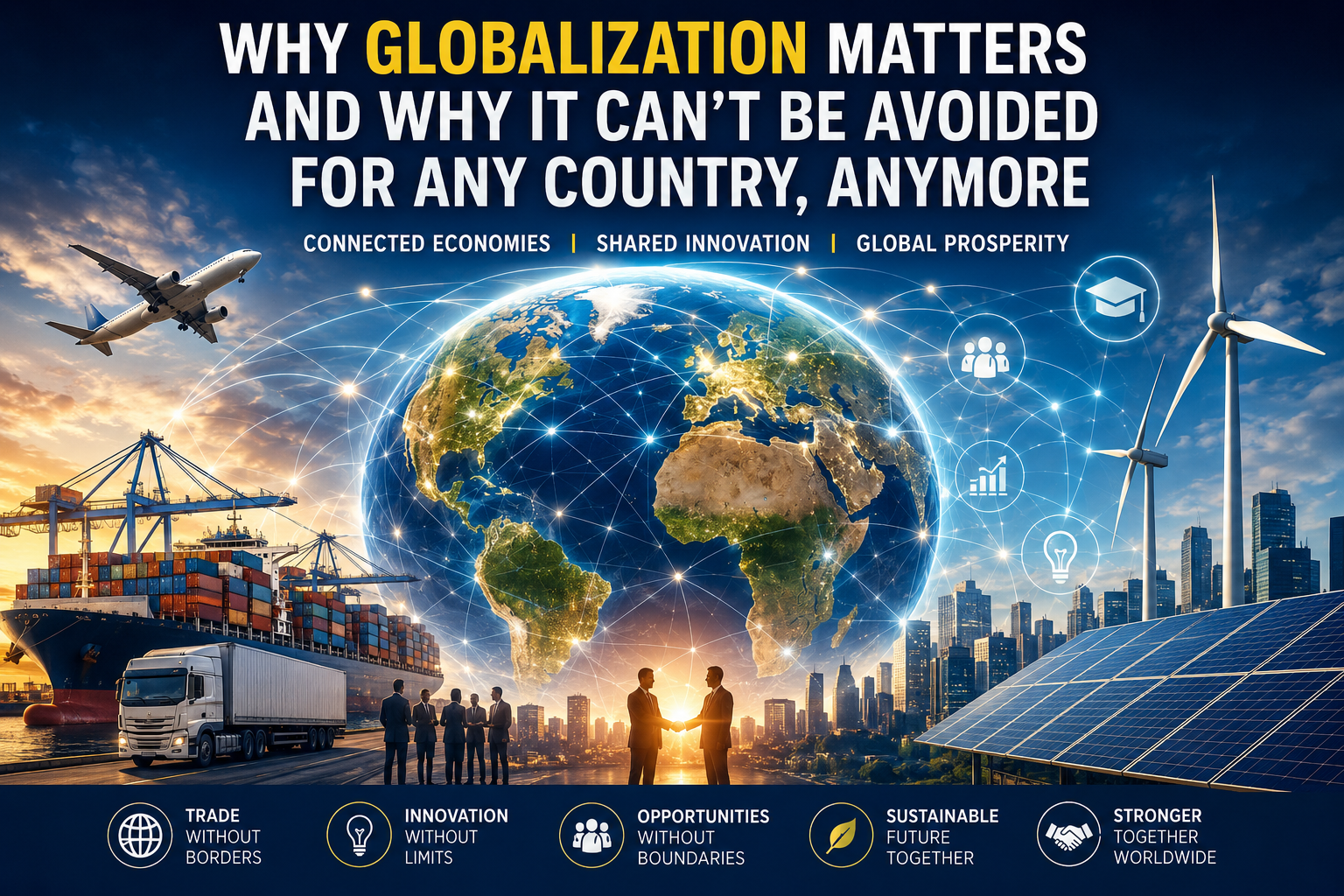
The World Has Become One Marketplace
For thousands of years, civilizations traded goods across deserts, oceans, and continents. The Silk Road connected Asia with Europe. Merchant ships crossed the Atlantic carrying commodities, ideas, and cultures. Today, globalization has evolved into something far greater than trade alone. It has become the operating system of the modern world.
Whether a nation chooses to embrace globalization or resist it, the reality is that every country is now connected through commerce, technology, finance, communication, environmental challenges, and human mobility. The decisions made in one part of the world increasingly influence the prosperity and security of another.
Globalization is no longer an option. It is a defining feature of the 21st-century economy.
What Is Globalization?
Globalization is the increasing integration of economies, businesses, cultures, technologies, and people across international borders. It enables countries to exchange products, services, investment, knowledge, talent, and innovation at an unprecedented scale.
Modern globalization includes:
- International trade
- Foreign direct investment
- Global supply chains
- Digital commerce
- Scientific collaboration
- International education
- Tourism
- Financial markets
- Artificial intelligence
- Renewable energy partnerships
- Healthcare research
- Climate cooperation
Technology has dramatically accelerated these connections. A startup in Canada can manufacture in Asia, sell in Europe, market through American platforms, and serve customers worldwide—all from a laptop.
Why No Country Can Avoid Globalization
Some governments attempt to isolate themselves through protectionist policies, trade barriers, or economic nationalism. While these measures may temporarily protect certain industries, complete isolation has become increasingly difficult.
Several powerful forces make globalization unavoidable.
1. Technology Has Eliminated Geographic Barriers
The internet has transformed the global economy.
Businesses now communicate instantly with suppliers, manufacturers, investors, and customers around the world. Cloud computing, artificial intelligence, blockchain, and digital payments have made international business accessible even to small companies.
Ideas now travel faster than physical products.
Countries that disconnect from technological progress risk falling behind in innovation, productivity, and competitiveness.
2. Supply Chains Are International
Very few products are made entirely within one country.
Consider a smartphone:
- Rare earth minerals may originate in Africa.
- Chips may be designed in North America.
- Components may be manufactured in East Asia.
- Software may be developed across several continents.
- Final assembly may occur elsewhere before global distribution.
The same interconnected model applies to automobiles, pharmaceuticals, electronics, medical equipment, clothing, and countless other products.
Modern economies depend on international cooperation.
3. Economic Growth Depends on Global Markets
Domestic markets have natural limits.
Businesses seeking sustained growth often expand internationally because larger customer bases create new opportunities, diversify revenue, and reduce dependence on a single economy.
Exports support employment, increase national income, and strengthen economic resilience.
Countries that actively participate in global trade generally have greater opportunities to attract investment, encourage entrepreneurship, and accelerate innovation.
4. Innovation Travels Across Borders
Scientific discoveries rarely remain confined to one nation.
Researchers collaborate internationally on vaccines, renewable energy, artificial intelligence, clean technology, agriculture, and advanced manufacturing.
Universities, multinational companies, governments, and research institutions share knowledge that benefits humanity as a whole.
Innovation grows faster when ideas circulate freely.
5. Capital Flows Across Nations
Investment today is global.
Pension funds, venture capital firms, sovereign wealth funds, private equity investors, and multinational corporations invest wherever they find opportunity.
Countries with stable institutions, skilled workforces, and predictable regulations are often better positioned to attract long-term investment.
Global capital fuels infrastructure, business expansion, job creation, and technological development.
The Economic Benefits of Globalization
When managed effectively, globalization offers significant advantages.
Higher Living Standards
Access to global markets increases competition, often expanding consumer choice while encouraging efficiency and innovation.
Job Creation
Export-oriented industries can create employment in manufacturing, technology, agriculture, logistics, finance, education, and professional services.
Faster Innovation
International collaboration speeds the development of new medicines, clean energy solutions, digital technologies, and advanced manufacturing processes.
Foreign Investment
International investors often provide the capital needed to build factories, research facilities, transportation networks, and renewable energy infrastructure.
Knowledge Transfer
Businesses adopt international best practices, improve productivity, and enhance workforce skills through collaboration with global partners.
The Challenges of Globalization
Globalization also presents important challenges that governments, businesses, and communities must address.
Income Inequality
The benefits of globalization are not always distributed evenly. Some industries expand rapidly while others decline, requiring thoughtful policies that support workforce adaptation and lifelong learning.
Supply Chain Disruptions
Events such as pandemics, natural disasters, geopolitical tensions, or shipping disruptions can affect production worldwide, highlighting the importance of resilient and diversified supply chains.
Environmental Pressures
Industrial growth and expanding trade can increase environmental impacts unless accompanied by cleaner technologies, sustainable manufacturing, and responsible resource management.
Cultural Concerns
Greater global connectivity can influence local traditions and identities. Many countries seek to preserve cultural heritage while participating in the global economy.
These challenges do not argue against globalization—they underscore the need for responsible governance, strategic planning, and international cooperation.
The Future Belongs to Collaborative Nations
The strongest economies of the future are likely to be those that combine openness with resilience.
Countries that invest in education, research, digital infrastructure, advanced manufacturing, and clean technologies will be well positioned to compete globally.
Rather than asking whether globalization should continue, policymakers increasingly focus on how to make globalization more inclusive, sustainable, and secure.
This means:
- Building resilient supply chains
- Encouraging innovation
- Supporting entrepreneurship
- Expanding workforce skills
- Investing in sustainable infrastructure
- Strengthening international partnerships
Clean Technology: A Global Opportunity
One of the clearest examples of globalization’s potential is the transition toward cleaner technologies.
Climate change, urbanization, indoor air quality, and sustainable construction affect countries worldwide. Innovations in energy efficiency, low-emission materials, cleaner manufacturing, and healthier buildings can be shared across borders, accelerating progress for everyone.
When businesses develop technologies that improve environmental performance and public health, international markets provide opportunities to scale those solutions far beyond a single country.
Global collaboration in clean technology benefits companies, investors, governments, and communities alike.
A New Era of Global Competition
The next decade will be shaped by competition in artificial intelligence, advanced manufacturing, biotechnology, quantum computing, cybersecurity, renewable energy, semiconductors, and sustainable infrastructure.
Countries that isolate themselves from international knowledge, investment, and trade risk slower growth and diminished competitiveness.
Those that embrace collaboration while protecting their strategic interests are better positioned to create high-value industries, attract talent, and improve living standards.
Globalization is increasingly about exchanging knowledge and innovation—not simply moving products across borders.
Conclusion
Globalization is one of the defining forces of modern civilization. It connects economies, accelerates innovation, expands opportunity, and enables countries to work together on challenges that no nation can solve alone.
While globalization brings complexities that require thoughtful management, the world has reached a point where complete economic isolation is neither practical nor advantageous. Every nation participates in global networks through trade, finance, technology, information, environmental cooperation, or human exchange.
The question is no longer whether globalization should exist.
The real question is how countries, businesses, and citizens can harness globalization to create more resilient economies, healthier societies, sustainable development, and shared prosperity.
In an interconnected world, success increasingly belongs to those who build bridges rather than barriers—leveraging global partnerships to solve local challenges while contributing to a stronger and more collaborative international economy.


